
critical essays
THE LIGHT OF EMOTION - SHANA NYS DAMBROT
Critical essay for The Consciousness Series published in The Huffington Post
The artist must train not only his eye but also his soul. —Wassily Kandinsky
Jill Joy is not satisfied with mere representation of the external world, however beautiful; and in her longing to instead more fully express her inner life has recourse to abstract gesture and the soulful power of color. Her lush, saturated, refined, and richly detailed paintings evoke rather than describe the contours and atmospheric jouissance of the natural world. They are not pictorial; they are not pictures. Executed in a kind of meditative semi-trance, they are more like artifacts, residues of the energy that produced them, both art historically/materially and spiritually galvanized process paintings of the highest order; and further, physical conduits of that same luminous energy, radiating into the world.

Jill Joy - Grey Skies - oil on canvas - 47x57” - 2014
Her glistening oil pigment Joy applies in bands, goops, and slathers, in impasto, flat rubs, and swaths, with brush, sponge, hand, and gravity as required. Passages proliferate with kaleidoscopic density of detail, alternating with areas of replete emptiness which is not negative space, but rather full with a tangible emptiness. Belonging to the family of painters who are evocative rather than depictive in the way they represent the realm of organically occurring events (geology, meteorology, astronomy, global curvature), if Joy doesn’t paint like the eye sees, it’s because she is not seeing with her eyes. These paintings do have a phenomenological relationship to the world of space, time, earth, land, and weather -- but Joy is using a different sight to perceive and then render the world in all its manifold dimensions, translated into paint and motion. She doesn’t of course, but one can almost imagine her painting with her eyes closed, so little is her truth a truth one of appearance -- and instead, a truth of feeling.
While her reference set is always tethered to experience, and even sometimes to place and time, Joy’s color palette is free to push beyond the strictures of naturalism, and even approach the kind of synesthesia Kandinsky, Rothko, Yves Klein and others have described. Her reds sweep the prismatic gauntlet from ruby to crimson, cherry enamel to fiery Autumn, sunset clouds to shadows in a glass of port. Pops of gold, blood orange, greens of forest and emerald intermingle with violet, ultraviolet, indigo, cold slate grey like flagstone walkways. Sweeps of inky, absorptive black; and from snow to diamonds more varieties of white than we would ever otherwise notice. Blue, of course, from dawn to dusk, to choppy water and glacial ices, prayer flags to sapphire, and blues that live only in the imagination.
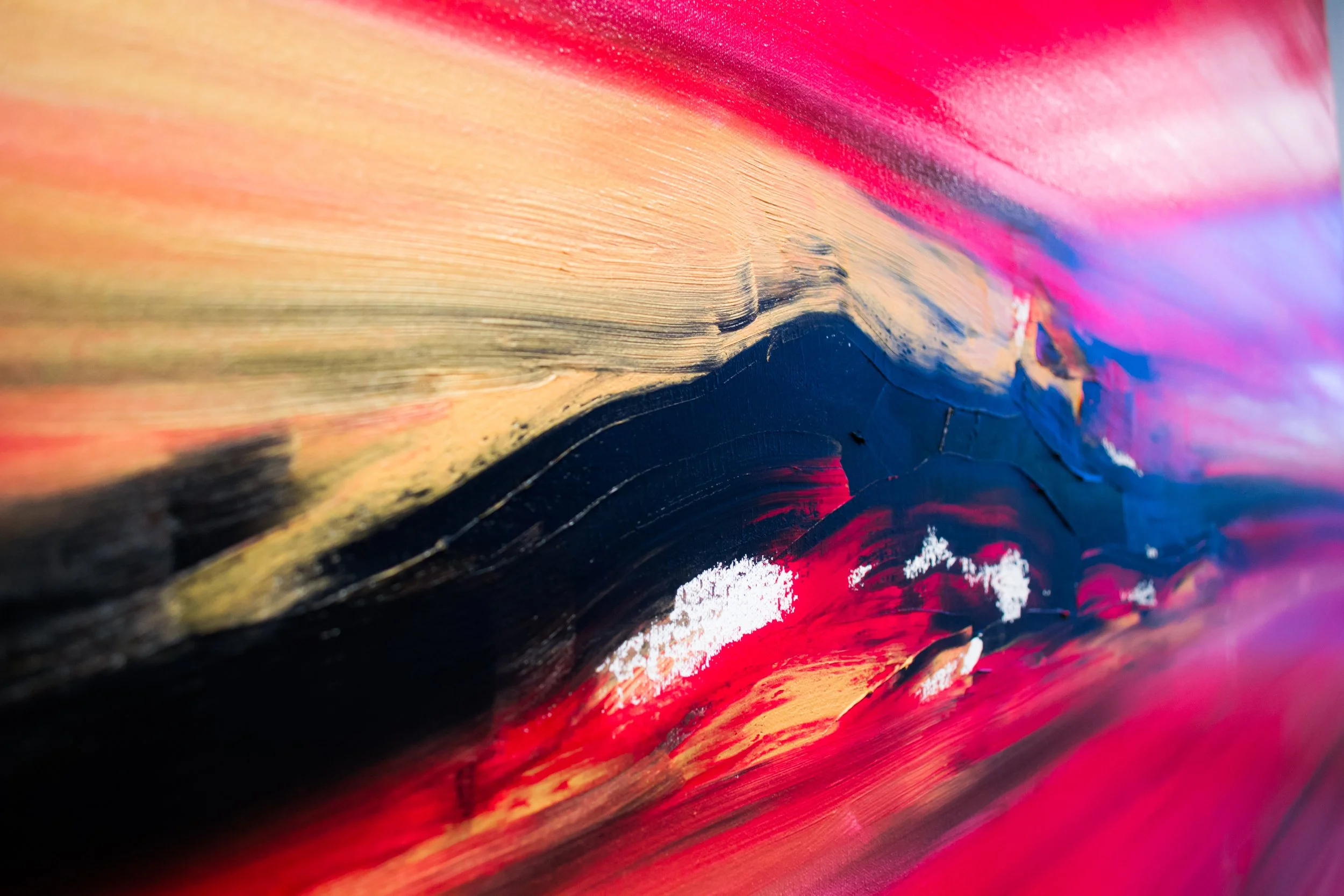
Jill Joy - Barrier - oil on canvas - 36x60” 2015 DETAIL
Notably, she also belongs to a tradition of artists who curate as part of their overall practice, feeling moved to bring other voices into both the formal and allegorical discourse she hopes to nurture. Physical and psychic energy is the major currency in Joy’s artistry, as she generates a sense of momentum, motion, and vastness even on a small scale. Her vistas keep the eye and body moving across light-filled, expansive picture planes. Both the right and left brain, so to speak, are engaged in experiencing and absorbing the emotions these paintings explore, tapping into the light and dark places of raw existence and the deliberate synchronicity of leaning toward the light.
Her roots are self-evidently spiritual -- William Blake, Eckhart Tolle -- and she describes her practice as one of the “evolution of consciousness with a mystical reference to the landscape.” Yet among her more modern kin she identifies Rothko, Matisse, JMW Turner, and other painters who located traces of the spiritual in the secular universe. Less literal, specific, or narrative than the new contemporary Visionary Art movement, Joy is nevertheless working in a karmic, post-verbal modality of symbol and secular spiritualism, gazing toward the horizon and walking the coastline of the Jungian sky and sea. She’d still be making them even if they were only ever for herself.
Shana Nys Dambrot is a Los Angeles based art critic and curator and regularly contributes to The Huffington Post, ArtLTD, Whitehot Magazine, and other publications.

Jill Joy - Gone But Not Forgotten - oil on canvas - 36x60” - 2015
THE LANDSCAPE OF EMOTION - Megan Abrahams
Critical essay for The Emotion Series.
The painting is my personal drama, but in the background there’s the larger divine. —Jill Joy
In her series Emotion, artist Jill Joy channels sorrow, loss, desire and passion into deeply layered paintings coursing with movement. Unfiltered, these feelings are catalysts for the powerful flow of paint across the canvas. Infused with energy, on
one level, the compositions suggest a determination to explore and resolve complex relationships among colors, textures and shapes as they coalesce on the surface. On a deeper level, the paintings are the product of Joy’s commitment to express the inner workings of her heart and soul to the outside world.
Largely self-taught, Joy gave up the security of a more conventional career and lifestyle to pursue the calling to paint, which for her, borders on a spiritual path. The desire to become an artist came about circuitously. During her junior year at Tufts, where she majored in history with a French minor, Joy went to Paris on an enriching study abroad program involving exposure to numerous museums. On her return, she took a photography class at the Museum of Fine Arts, Boston, accredited by Tufts. One day, the photography teacher made a comment that left an indelible
impression on her: “You know, you have an eye.”

Jill Joy - She’s Come Undone - oil on canvas - 60x72” - 2015
After graduation, rather than attending law school as she had planned, Joy began working at the McKee Gallery in New York City. “That’s where I decided I wanted to be an artist,” she recalls. “But I thought I would be a photographer.” In the course of her soul searching, Joy became captivated by painting, even dreaming about it.
Her work derives from the genre of action painting in the abstract expressionist tradition, motivated by the impulse to convey universal emotions, translating the unconscious through a synthesis of physical gesture and psychic energy. Rather than relying solely on brushes, she employs aggressive tools like trowels and scrapers to manipulate the paint in dynamic swaths of color. Glimmers of unpainted canvas are sometimes left exposed, as if admitting light. Oil paint, with its elemental properties – rich, luminous color and viscosity – seems her natural medium. Her palette – bold, ardent, predominately red, black and white, with regions of blue and hints of yellow – evokes the landscape of emotion. Of the colors, Joy says, “They are symbolic of emotional states. I don’t choose them. They choose me.”
She approaches the canvas with an idea 80 percent conceived through a subconsciously derived inner vision. The rest unfolds organically in the act of painting. Ultimately, the
work appears to have been realized through a process largely choreographed by instinct.
It represents nothing other than the pure portrayal of the artist’s most personal essence, exposing the rawness of the emotions that drive her.
Megan Abrahams is a Los Angeles based art critic. She is the editor of Fabrik Magazine and regularly contributes to ArtLTD Magazine, Whitehot Magazine, and other publications.

Jill Joy - Do You Love Me - oil on canvas - 60x48” - 2015